Could Sequence Risk Affect Your Pension During Drawdown?
Wednesday 19 August, 2026
“Sequence of returns risk” is an important consideration when taking an income from an invested pension. For anyone approaching retirement or already taking an income through pension drawdown, understanding how investment performance can affect the sustainability of retirement income is an important part of effective retirement planning.
When you move from building up your pension to using it to provide an income, the way investment returns occur can have a significant impact on the value of your remaining pension and how long your money may last.
As Financial Advisers providing professional pension advice and retirement planning, we can help you understand the risks involved and consider strategies that may help manage them in line with your personal circumstances.
Harry Goodship, Independent Financial Adviser (IFA), Ringwood, Hampshire said:
“Sequence of returns risk is something that can become particularly important when you move from saving into a pension to taking money out of it. Two people could have the same pension value and experience the same average investment return over their retirement yet end up with very different outcomes simply because their investment returns happened in a different order.”
What is sequence of returns risk?
“Sequence risk” refers to the risk that the order in which investment returns occur can have a significant impact on your pension when you are taking regular withdrawals.
It is particularly relevant at and during retirement, when clients transition from saving money into their pension to spending their accumulated savings. It is especially important when considering pension drawdown, where your pension remains invested while you take an income from it.
The important point is that sequence of returns risk is not primarily about when you first start investing. It becomes particularly relevant when you start withdrawing money from an invested pension, especially during the early years of retirement.
The investment returns immediately before and after you begin taking an income can therefore be particularly important. If markets fall significantly during these early withdrawal years, continuing to take a regular income can mean selling investments when their values are lower.
How can sequence of returns risk affect your pension?
If your pension remains invested and you require a regular income from your pension, the order of returns can make a significant difference to your remaining pension value.
For example, if you suffer negative investment returns in the early years after beginning pension withdrawals, it can have a dramatic effect on your remaining pension value. This is because you may have to sell investments when their prices are falling to generate a fixed level of income.
If prices are lower, you need to sell more investments to generate that same level of fixed income. Once those investments have been sold, they are no longer available to benefit from future investment growth.
Then, if markets recover in future years, you have fewer investments remaining to benefit from that recovery.
This is why two pension investors can experience the same investment returns over a long period but achieve very different outcomes depending on the sequence in which those returns occur.
An example of sequence of returns risk
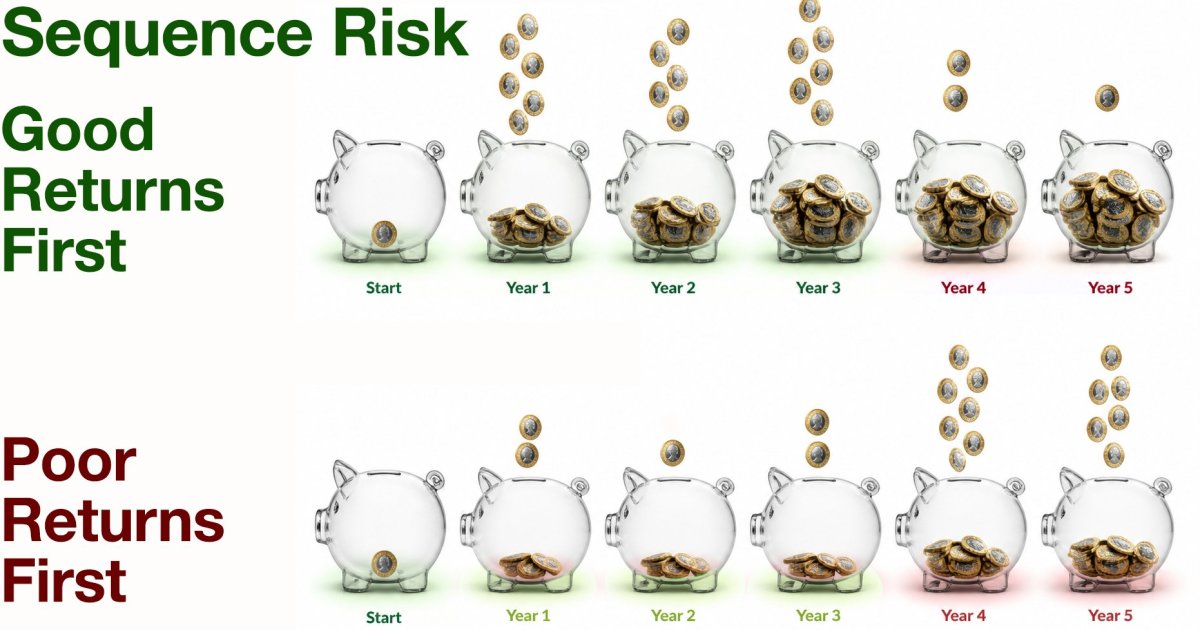
Imagine two people have identical pension investments, and each withdraws the same amount every year.
One experiences several years of strong investment performance when they first begin taking an income, followed by weaker returns later.
The other experiences poor investment performance in their first few years of retirement, followed by stronger returns later.
Even if the overall average return experienced by both investors is the same, the person experiencing the poor returns at the beginning may be left with a smaller pension because they have been withdrawing money while their investments have fallen in value.
This is the essence of sequence of returns risk.
Who is most exposed to sequence of returns risk?
The more volatile your investments, the more exposed you may be to sequence of returns risk, particularly when you are taking regular withdrawals.
The higher your drawdown need as a percentage of your pension value, the greater the potential impact can be.
This is why pension advice and retirement planning should consider not just the potential long-term investment return, but also how much income you need, when you need it and how your investments may perform during the early years of retirement.
How can you manage sequence of returns risk?
The good news is that there are a variety of strategies that can be used to reduce and manage sequence of returns risk.
Each has merit, but deciding on the most appropriate approach will depend on many factors and should be explored in detail based on your personal circumstances.
There is no single strategy that will be right for everyone. A financial adviser can help you consider the different approaches alongside your investment objectives, income requirements, attitude to investment risk and capacity for loss.
1. Emergency cash and cash reserves
One possible approach is to retain cash reserves, in addition to your normal emergency cash, to help meet expenditure during periods when investment markets are falling.
For example, some people may choose to retain up to two years of cash reserves. This can potentially allow you to stop or reduce withdrawals from your pension during a stock market decline and use cash to meet expenditure needs instead.
The appropriate level of cash will depend on your individual circumstances, including your income requirements, other sources of income and overall retirement plan.
2. Using investment buckets
Another approach is to segregate different asset classes within your pension to meet different financial needs.
For example, you could consider keeping around two years of planned withdrawals in cash or cash equivalents, with potentially less volatile investments used for medium-term expenditure needs and equities or other real assets retained for longer-term requirements.
One possible example could be:
- Short term: Cash or cash equivalents for immediate expenditure needs.
- Medium term: Potentially less volatile investments, including certain fixed-income investments, for expenditure over the following years.
- Long term: Equities and other real assets for money that may not be required for seven years or more.
This type of approach is sometimes referred to as a bucket strategy. However, the appropriate asset allocation will depend on your circumstances and investment objectives, and investments such as fixed-income assets can themselves fall in value.
3. Using an annuity
Another option is to use part of your pension to purchase an annuity.
A lifetime annuity can provide a guaranteed income for life, depending on the terms selected. Using part of your pension in this way can remove investment risk in respect of the funds used to purchase the annuity, although other risks remain.
For example, you may still be exposed to inflation risk unless you choose an inflation-linked annuity.
An annuity can therefore form part of a wider retirement income strategy, potentially providing a guaranteed income to cover some essential expenditure while other pension funds remain invested.
4. Taking a flexible income
Another approach is to be prepared to adjust the income you draw from your pension.
Where your circumstances allow, you could consider reducing the income you take during periods of negative investment performance. Similarly, you may be able to increase your income during periods of stronger investment performance.
This flexibility can help reduce the amount that needs to be withdrawn from investments following a market fall.
However, increasing or reducing pension withdrawals should always be considered alongside your wider retirement plan, expenditure needs and long-term financial objectives.
Harry Goodship, Independent Financial Adviser in Ringwood said:
“There isn't a single solution to sequence of returns risk. The right approach depends on how much income you need, how long you expect your pension to provide an income, the investments you hold and how much flexibility you have around your withdrawals. Good pension advice looks at all of these factors together rather than focusing on investment returns in isolation.”
Sequence of returns risk is only one retirement planning consideration
While sequence of returns risk is an important consideration for anyone taking an income through pension drawdown, it is only one of the risks that should be considered as part of retirement planning.
Other factors can include:
- How long your pension needs to provide an income.
- The level of income you require.
- Investment performance and volatility.
- Inflation and the rising cost of living.
- The level and sustainability of your withdrawals.
- Your attitude to investment risk.
- Your capacity for loss.
- Tax considerations.
- Charges associated with your pension and investments.
- Other sources of retirement income.
This is why professional financial advice for pensions and retirement planning can be valuable when approaching retirement or deciding how to take an income from your pension.
Getting the right pension advice for your circumstances
Approaching and entering retirement, and then moving through your early retirement years, can introduce different financial risks from those you may have experienced while working and saving.
The decisions you make about your pension, investments and retirement income can have a significant impact on your future financial position.
There is no single pension drawdown strategy that will be suitable for everyone. The right solution will depend on your personal financial needs, your attitude to investment risk, your capacity for loss and your wider retirement objectives.
A Financial Adviser can help you understand these different considerations and build a retirement income strategy around your individual circumstances.
Financial Advisers Howard Goodship, Stewart Sims-Handcock, and Harry Goodship are available for a no-cost, no-obligation initial chat to discuss your personal requirements and the pension advice you may need as you approach or move through retirement.
Pension Advice and Financial Planning from Lonsdale Wealth Management
Howard Goodship, Stewart Sims-Handcock and Harry Goodship are Independent Financial Advisers with Lonsdale Wealth Management, 5 Friday’s Court, Ringwood.
Telephone: 01425 208490 or 01727 845500
Website: www.lonsdaleservices.co.uk
If you are approaching retirement, already taking an income from your pension or considering pension drawdown, professional pension advice and retirement planning can help you understand the options available and the risks that need to be considered.
Important information: The value of an investment and the income from it could go down as well as up. The return at the end of the investment period is not guaranteed and you may get back less than you originally invested. The contents of this article are for information purposes only and do not constitute individual advice. A pension is a long-term investment not normally accessible until age 55 (57 from April 2028 unless the plan has a protected pension age). Your pension income could also be affected by the interest rates at the time you take your benefits.
Latest News Next Article Previous Article