
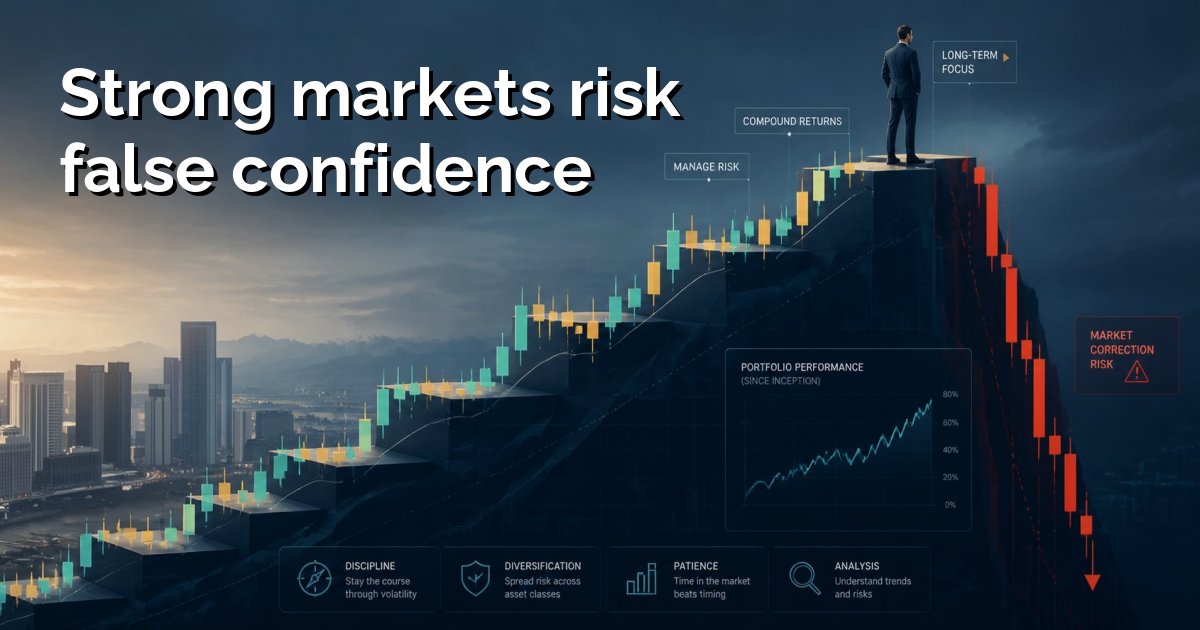
Investing in Rising Markets: Why Confidence Isn’t the Same as Control
Thursday 25 June, 2026
When markets are climbing, investing can feel reassuringly straightforward. Portfolios rise, headlines look positive, and even modest decisions can appear to be the “right” ones in hindsight. It’s very easy in these conditions to believe success is down to skill, timing, or clever stock selection.
But as many experienced investors eventually discover, rising markets can mask underlying risks. What feels like control in the short term can quickly shift when conditions change.
As Conor McClean, Independent Financial Adviser (IFA) in St Albans, Hertfordshire puts it:
“Strong markets can give investors a false sense of confidence. The real value of a financial plan is only truly tested when markets become uncomfortable.”
This is where long-term thinking really begins to matter.
Why Strong Markets Can Create a False Sense of Investment Skill
During periods of growth, it’s common for a small group of well-known companies or sectors to drive most of the returns. If an investor holds these names, their portfolio can rise significantly over a relatively short period of time.
This often leads to a natural assumption: “I’m doing something right.”
However, this can be misleading. In reality, much of the return may be coming from broad market momentum rather than individual stock selection. The danger is that this success encourages concentration rather than caution, with investors becoming more heavily exposed to a small number of holdings.
The issue only becomes clear when conditions reverse.
What Happens When Markets Fall
The real test of any investment approach is not how it behaves in rising markets, but how it holds up when things become uncertain.
When markets decline:
- Emotions tend to take over rational decision-making
- Investors are more likely to react quickly rather than think long term
- Portfolios that are heavily concentrated can experience significant losses
A portfolio that felt strong during growth periods can suddenly feel fragile when a handful of holdings fall sharply at the same time.
This is where many investors begin to question whether short-term gains were ever aligned with their long-term financial goals.
Why Portfolio Concentration Increases Risk
Holding a small number of investments can work well when those assets are performing strongly. The challenge is that markets are unpredictable, and leadership changes over time.
A concentrated portfolio increases dependency on:
- A few companies performing consistently well
- Specific sectors continuing to outperform
- The investor’s ability to time entry and exit correctly
If even one or two key holdings fall significantly, the impact on overall wealth can be substantial. This is why diversification becomes so important in long-term planning.
The Role of Diversification in Long-Term Investing
Diversification is not about avoiding risk altogether. Instead, it is about managing it in a way that makes outcomes more stable and predictable over time.
A well-diversified equity portfolio aims to:
- Capture global economic growth across multiple regions and sectors
- Reduce reliance on any single company or theme
- Smooth out the impact of individual winners and losers
- Help investors remain invested through periods of volatility
Importantly, diversified portfolios are not designed to outperform every year. Instead, they aim to deliver more consistent long-term results by reducing the impact of extreme outcomes.
This approach recognises a key truth of investing: you don’t need to be right all the time, but you do need to avoid being overly wrong in the wrong moments.
What the Data Shows About Active Investing
Long-term research consistently highlights the challenge of outperforming the broader market through active stock selection.
For example, S&P SPIVA (S&P Indices versus Active) reports regularly show that a large proportion of active fund managers underperform their benchmarks over extended time periods. In the US, more than 85% of funds have historically failed to outperform the S&P 500 over longer horizons.
While past performance is never a guarantee of future results, the evidence strongly supports the idea that consistent outperformance through stock picking is difficult to achieve over time.
This reinforces the importance of diversification and disciplined portfolio construction rather than relying on individual investment decisions to drive long-term outcomes.
Why Investor Behaviour Matters More Than Market Performance
One of the most overlooked risks in investing is not the market itself, but how investors respond to it.
Many long-term losses are not caused purely by market downturns, but by behaviour during those downturns:
- Selling during periods of stress
- Switching strategies too frequently
- Chasing performance after strong runs
A sound investment strategy should therefore do more than aim for returns. It should also help investors stay invested through uncertainty.
How a Financial Adviser Can Help You Stay on Track
A professional financial adviser plays an important role in turning investment theory into a practical, structured plan that fits your individual goals and circumstances.
They can help by:
- Building a diversified portfolio aligned with your risk tolerance and time horizon
- Providing perspective during periods of market volatility
- Helping prevent emotional decision-making during downturns
- Regularly reviewing whether your investments still support your long-term objectives
- Explaining how short-term market movements fit into a wider financial strategy
Importantly, advice is not just about selecting investments. It is about creating clarity, structure, and discipline so that decisions are made with context rather than emotion.
Final Thought: It’s About Being Consistent
Investing can feel rewarding when markets are rising, but the real measure of a strategy is how it performs when conditions change.
Long-term success is rarely about picking winners or chasing short-term returns. It is about building a balanced, diversified approach that can withstand uncertainty and keep you aligned with your financial goals.
Markets will always move through cycles. The aim is not to predict them, but to be prepared for them.
Please note: The value of an investment and the income from it can go down as well as up. The return at the end of the investment period is not guaranteed, and you may get back less than you originally invested. The contents of this article are for information purposes only and do not constitute individual financial advice. The Financial Conduct Authority does not regulate tax advice.
Latest News Next Article Previous Article