
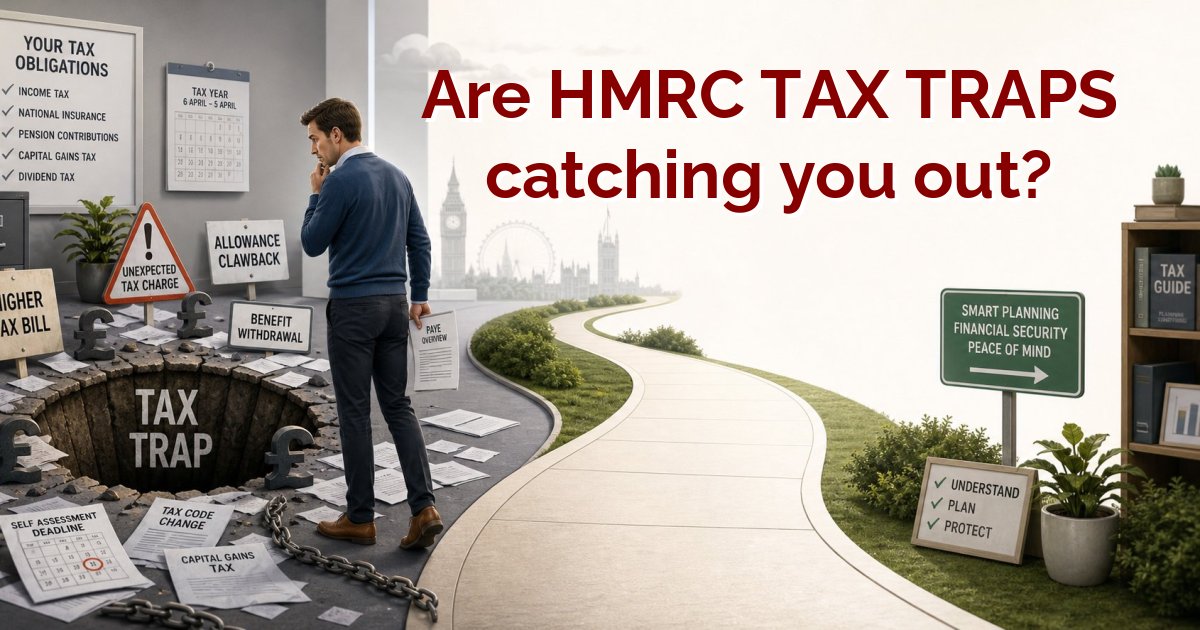
Understanding Income Tax Traps
Wednesday 15 July, 2026
For many individuals and families, understanding income tax is no longer simply about knowing the basic, higher and additional tax rates. The UK tax system contains several threshold-based rules, tapered allowances and benefit withdrawal points that can significantly affect your overall financial position.
Many people are surprised to discover that a pay rise, bonus or increase in income can sometimes lead to a much smaller increase in take-home pay than expected. In some circumstances, higher earnings can even result in the loss of valuable allowances and benefits.
At Lonsdale, our Financial Advisers and Wealth Management Planners regularly help clients across St Albans and the wider UK understand how tax thresholds may affect their personal financial planning.
Conor McClean, Independent Financial Adviser (IFA) in St Albans, Hertfordshire said:
“Many people focus on tax rates, but the biggest financial impact often comes from the thresholds hidden within the system. Understanding where these sit, with the help of a financial adviser, can help you make more informed decisions about your income, pensions and long-term financial plans.”
UK Income Tax Rates and Thresholds 2026/27
For taxpayers in England, Wales and Northern Ireland:
|
Band |
Income |
Tax Rate |
|
Personal Allowance |
Up to £12,570 |
0% |
|
Basic Rate |
£12,571 – £50,270 |
20% |
|
Higher Rate |
£50,271 – £125,140 |
40% |
|
Additional Rate |
Over £125,140 |
45% |
A Key Point to Remember
The UK income tax system is progressive. This means that higher rates of tax only apply to income above each threshold, not to your entire income.
Hidden Tax Trap 1: Fiscal Drag and Crossing the Higher-Rate Tax Threshold
What is Fiscal Drag?
Fiscal drag occurs when tax thresholds remain frozen while earnings increase.
Although tax rates themselves do not change, more income gradually falls into higher tax bands over time. This can result in a larger tax bill without any formal increase in tax rates.
Because of this, fiscal drag is often referred to as a "stealth tax".
Current income tax thresholds are frozen until at least the 2030/31 tax year.
Example 1 – Fiscal Drag
Mary earns £48,000 and is comfortably within the basic-rate tax band.
The following year she receives a 5% pay rise, increasing her salary to £50,400. While this increase broadly keeps pace with inflation, the higher-rate tax threshold remains frozen at £50,270.
As a result, part of her income, £130, is now taxed at 40% instead of 20%.
Although her salary has increased, her tax bill rises by more than she expected and, in real terms, inflation has reduced the benefit of her pay rise.
Hidden Tax Trap 2: The Personal Savings Allowance Reduction
How Your Savings Interest Can Be Affected
Basic-rate taxpayers can receive up to £1,000 of savings interest tax-free through the Personal Savings Allowance (PSA).
However:
- Basic-rate taxpayers: £1,000 PSA
- Higher-rate taxpayers: £500 PSA
- Additional-rate taxpayers: £0 PSA
Example 2 – Savings Allowance Reduction
If Mary also earns £1,000 in savings interest, becoming a higher-rate taxpayer reduces her PSA from £1,000 to £500.
As a result, £500 of her interest becomes taxable at 40%.
This creates an additional tax liability of £200.
Mary is therefore paying more tax on both her earnings and her savings despite only receiving a relatively modest pay increase.
This illustrates how fiscal drag can have wider consequences beyond employment income.
Hidden Tax Trap 3: The Personal Allowance Taper and the 60% Effective Tax Rate
Earning More Than £100,000
One of the least understood areas of the UK tax system affects those with income above £100,000.
How It Works
For every £2 earned above £100,000:
- £1 of Personal Allowance is lost.
- The Personal Allowance is completely removed once income reaches £125,140.
Effective Tax Rates
This creates an effective marginal tax rate of:
- 60% between £100,000 and £125,140
- Approximately 62% when National Insurance is included
For those repaying student loans:
- Around 68% with a Postgraduate Loan
- Around 71% with Plan 1, Plan 2, Plan 4 or Plan 5 student loans
Example 3 – Personal Allowance Taper + Student Loan
Jonathan earns a salary of £100,000 and has a Plan 2 student loan.
After a successful year, he receives a £20,000 bonus from his employer.
Following income tax, National Insurance and student loan deductions, he receives approximately £5,800 from the £20,000 bonus.
This demonstrates how significantly deductions can affect higher earners.
Hidden Tax Trap 4: Childcare Benefit Cliff Edge at £100,000
Families Can Be Particularly Affected
If your adjusted net income exceeds £100,000, you may lose access to:
- Tax-Free Childcare (worth up to £2,000 per child per year)
- 30 hours free childcare support
Important Rule
Unlike some tax rules, this is not tapered.
The cut-off is effectively immediate once income exceeds £100,000.
Example 4 – Childcare Benefits
If Jonathan also has two children attending nursery full-time, he may still only receive £5,800 from his bonus.
However, he could lose childcare support worth up to £10,000 per child.
In this example, a £20,000 bonus could leave the family approximately £14,200 worse off overall.
This represents an effective tax rate of 171%.
In extreme circumstances, even a small increase in income could trigger the loss of substantial childcare support.
Hidden Tax Trap 5: Child Benefit High Income Charge
Earning More Than £60,000
For the 2026/27 tax year, Child Benefit is:
- £27.05 per week for the eldest or only child
- £17.90 per week for each additional child
For two children, this equates to £2,337.40 annually.
How the Charge Works
Where adjusted net income exceeds £60,000:
- 1% of Child Benefit is repaid for every £200 of income above £60,000
- Child Benefit is fully withdrawn at £80,000
Example 5 – Child Benefits & High Income
Sophie earns £60,000, has a Plan 2 student loan and has two children.
She receives a £20,000 bonus, increasing her income to £80,000.
After income tax, National Insurance and student loan deductions, she receives £9,800 from the bonus.
However, she also loses £2,337.40 through the Child Benefit High Income Charge.
This leaves her with £7,462.60.
The effective tax rate on her bonus is therefore approximately 62.7%.
Tax Efficiency Considerations
Ways to Improve Tax Efficiency
Tax planning should always be considered in the context of your personal circumstances and objectives.
Depending on your situation, a Financial Adviser can help you explore areas that could improve tax efficiency, including:
Pension Contributions
Making pension contributions can help reduce adjusted net income, potentially preserving allowances and benefits that may otherwise be lost.
Salary Sacrifice Arrangements
Some employers offer salary sacrifice schemes which can improve tax efficiency while increasing pension contributions.
Managing Bonuses and Dividends
The timing of bonuses, dividends and other income can sometimes affect which tax thresholds apply in a particular tax year.
Making Use of Available Allowances
Individuals should ensure they understand the allowances and exemptions available to them, including pension allowances, ISA allowances and savings allowances where appropriate.
Tax rules can be complex and may change over time, so professional financial advice is often valuable.
Key Questions to Ask About Your Own Circumstances
Every individual's position is different.
If any of the issues discussed in this article apply to you, consider asking:
- Am I close to a major tax threshold?
- Could a pay rise or bonus affect my tax position?
- Am I at risk of losing Child Benefit or childcare support?
- Would additional pension contributions help reduce my adjusted net income?
- Am I making full use of my ISA and pension allowances?
- How tax-efficient are my savings and investments?
- Could my student loan repayments significantly affect the value of a bonus?
- Do I understand my effective marginal tax rate?
These questions can help identify planning opportunities that may otherwise be overlooked.
Important Income Thresholds to Monitor
In the tax year 2026/2027 the following thresholds are particularly important for many UK taxpayers:
- £50,270 – Entry into higher-rate income tax.
- £60,000 – Beginning of the Child Benefit High Income Charge.
- £100,000 – Personal Allowance taper begins and eligibility for certain childcare benefits can be lost.
- £125,140 – Personal Allowance fully removed.
Why Professional Financial Advice Matters
Understanding tax rates is relatively straightforward.
Understanding how multiple tax rules, allowances and benefit withdrawal mechanisms interact is often much more complex.
At Lonsdale, our Financial Advisers and Wealth Management Specialists work with individuals and families across St Albans and the wider UK to help them understand their financial position and make informed decisions.
Professional financial advice can help you:
- Understand the impact of tax thresholds on your finances.
- Assess whether pension contributions may be appropriate.
- Review your overall tax efficiency.
- Plan around major life events and changing income levels.
- Build a long-term financial strategy aligned with your objectives.
Please remember that tax treatment depends on individual circumstances and may change in the future. Financial planning recommendations should always be based on your personal situation.
Key Takeaways
- The UK tax system contains several hidden tax traps and threshold-based cliff edges.
- Fiscal drag can increase tax bills without any increase in headline tax rates.
- The £100,000 to £125,140 income range remains one of the least tax-efficient areas of the tax system.
- Families with children can be disproportionately affected by the withdrawal of benefits.
- Small increases in income can sometimes have unexpectedly large consequences.
- Effective tax planning is increasingly about understanding thresholds as well as tax rates.
For many people in St Albans and across the UK, understanding these rules can make a meaningful difference to long-term financial outcomes. Taking advice before making financial decisions may help you better understand the options available and how they relate to your individual circumstances.
Important Information
This article is for information purposes only and does not constitute financial advice or a recommendation to take any particular course of action. Tax treatment depends on individual circumstances and may be subject to change. The value of investments can fall as well as rise, and you may get back less than you originally invested. Examples within this article are illustrative only, actual outcomes depend on individual circumstances, tax status, student loan type and prevailing tax rules. The Financial Conduct Authority does not regulate tax advice.
Latest News Next Article Previous Article