
What’s Next for Bond Investors?
Tuesday 6 October, 2026
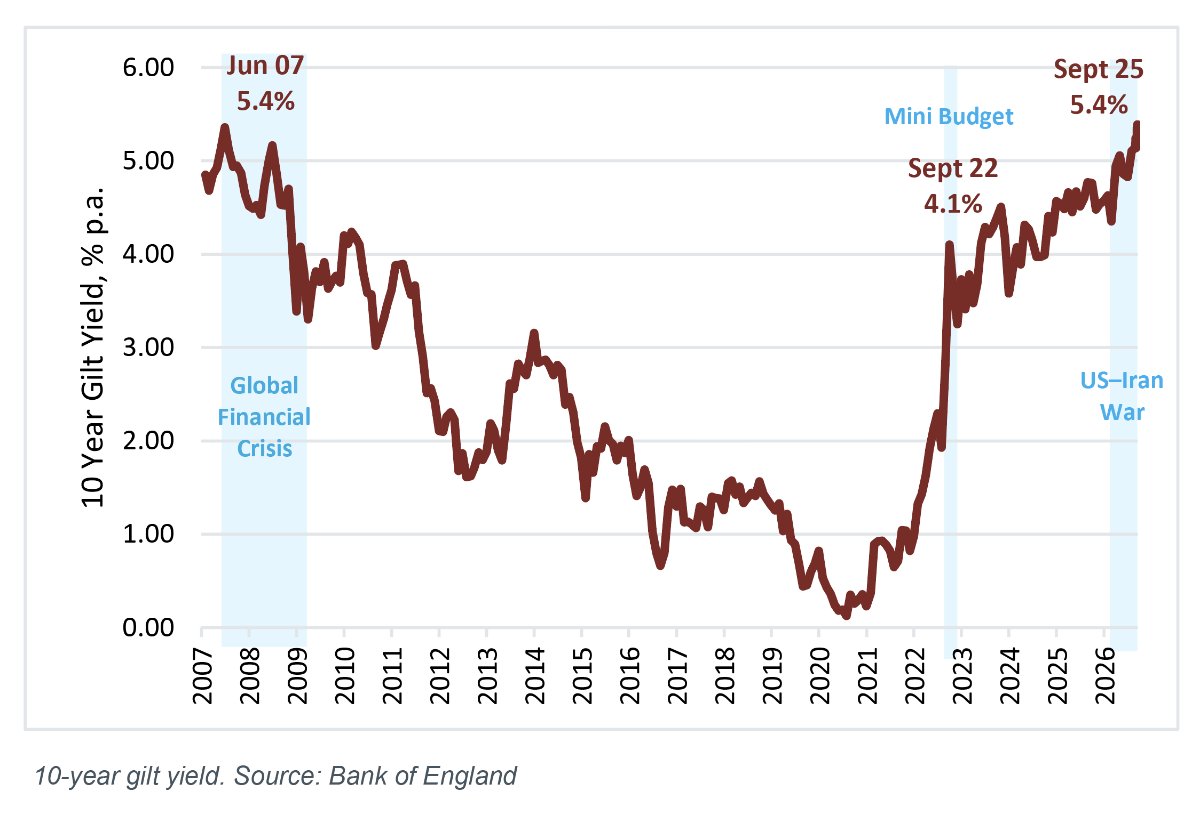
Bond markets have experienced a significant change in recent years, with yields continuing to move higher. In September, the yield on a 10-year UK gilt reached 5.4%, its highest level since 2007, while the 30-year gilt yield climbed to 5.9%, a level not recorded since 1998.
There are several reasons for the recent increase in bond yields. Continuing tensions in the Middle East have contributed to higher oil and gas prices, increasing concerns that inflation could become more persistent later in the year.
At the same time, economic growth has remained resilient, prompting financial markets to move away from expectations of central bank interest rate cuts in 2026 towards the possibility of further increases. The European Central Bank and US Federal Reserve have already taken action, while the Bank of England may also increase rates.
The amount of debt being issued has also increased considerably. Governments across developed markets are continuing to borrow, while significant investment by artificial intelligence hyperscalers has added further bond issuance.
This greater supply is meeting softer demand from some traditional purchasers, including defined benefit pension schemes, which has added further upward pressure to yields.
Key points for bond investors
- The rise in bond yields has been a notable feature of recent years. In September, the 10-year gilt yield reached 5.4%, the highest level since 2007, while the 30-year yield reached 5.9%, its highest level since 1998.
- When yields rise, existing bond prices generally fall in the short term. However, higher starting yields can provide more attractive risk-adjusted return potential and a greater income cushion if yields rise further.
- Maintaining diversification across different types of bonds can help provide greater stability and reduce portfolio volatility, particularly because the relationship between bond and equity returns can change over time.
What does the current environment mean for investors?
There is likely to be continued volatility while markets respond to inflation, interest rates, economic growth and geopolitical developments. For investors, this reinforces the importance of keeping a well-diversified portfolio and maintaining a long-term perspective rather than allowing short-term market movements to dictate investment decisions.
Higher yields can create greater return potential
Higher bond yields are not necessarily negative for investors who are considering bonds today. If yields remain elevated for an extended period, the income available from bonds can provide a more attractive starting point.
There is also the potential for capital gains if yields subsequently fall. Bond prices and yields generally move in opposite directions, so a reduction in yields can lead to an increase in bond prices and boost returns. Even where yields increase modestly, the income generated by a bond can still contribute to a positive overall return.
Of course, bonds are not without risk. Their value can fluctuate, and investors should consider how different types of bonds could behave in different economic and market conditions.
Bonds can still play an important diversification role
Bonds can provide diversification because they do not always produce returns that move in the same direction as equities.
The relationship between the two asset classes is often described using correlation. A negative correlation means bond and equity returns tend to move in opposite directions, while a correlation close to zero suggests there is little or no relationship between their movements.
In recent years, bond and equity returns have generally shown a positive correlation, partly reflecting the influence of concerns about inflation across both markets. Looking ahead, government bonds can still have an important role within a diversified portfolio, particularly given their current levels of income and their potential to provide support during economic shocks.
However, the relationship between government bonds and global equities can change over time. For this reason, government bond holdings can be complemented by other types of bonds to provide broader diversification.
How are we approaching bonds within portfolios?
At Lonsdale, our financial advisers believe diversification remains an important consideration when investing in bonds. Holding a range of bond asset classes can provide exposure to different sources of return while helping to manage portfolio volatility in a changing market environment.
The different areas of the bond market each have their own characteristics and can make a different contribution to a diversified portfolio.
|
Bond asset class |
What it is |
Why it can help diversify |
|
Government bonds |
Loans to UK and overseas governments. Investors receive interest and, subject to the issuer meeting its obligations, their original capital at maturity. |
Higher-quality government bonds can provide resilience during periods of growth-related market stress. Investing globally can also spread interest-rate and regional risks. |
|
Investment Grade Credit |
Loans to financially stronger companies with investment-grade credit ratings. These bonds can provide additional income compared with government bonds. |
They combine income with some sensitivity to interest rates while spreading exposure across different companies, sectors and geographical regions. |
|
Asset-Backed Securities |
Investment-grade, floating-rate bonds supported by pools of assets such as residential mortgages, corporate loans, car loans and consumer credit. |
They provide another source of income beyond government and corporate bonds. Their floating-rate structure means returns are more closely linked to short-term interest rates, giving them very limited sensitivity to changes in government bond yields. |
|
High Yield |
Loans to companies with lower credit ratings. Investors receive a higher yield in return for accepting greater default risk. |
These bonds are more return-seeking, with their income and mix of issuers providing a way of diversifying traditional bond holdings and supporting returns alongside equities. |
|
Emerging Market Debt |
Bonds issued by governments and companies in emerging markets, denominated either in emerging-market currencies or US dollars. |
This gives investors exposure to different economies, currencies and sources of return, with the potential for higher income than developed-market government bonds. |
|
Multi Asset Credit |
Actively managed funds with the flexibility to invest across several bond and credit markets, including investment grade, high yield and asset-backed securities. |
The wider range of opportunities allows managers to adjust credit quality and risk as market conditions change, providing flexibility and diversification away from traditional bond exposure. |
Looking beyond short-term market movements
The recent rise in bond yields can understandably cause concern, particularly for investors who have seen the value of existing bond holdings fall as yields have increased.
However, the relationship between bond prices and yields also means that today's higher yields can change the longer-term investment opportunity. Higher yields can provide investors with a greater level of income, while potentially offering an additional source of return should yields subsequently fall.
The current market environment also highlights why diversification matters. Different types of bonds have different levels of interest-rate, credit, currency and default risk, meaning they can respond differently as economic and market conditions change.
For investors, therefore, the question is not simply whether bond yields are rising or falling. It is also about how bonds fit into the wider portfolio, the level of income required, investment timescales, attitude to risk and the ability to withstand periods of market volatility.
How Lonsdale can help
As a Chartered Financial Planner and Independent Financial Adviser (IFA) in Ringwood, Hampshire, Howard Goodship can help you understand how bonds and other investments could fit within your wider financial plans.
Howard said “With bond yields having risen significantly, it is understandable that investors may be wondering what this means for their portfolios and whether any changes are needed. At Lonsdale, our financial advisers can help customers understand how different types of bonds may fit within a diversified investment portfolio, taking into account their individual circumstances, objectives and attitude to risk. We can also provide ongoing guidance as market conditions change, helping clients keep their investments aligned with their longer-term financial plans.”
At Lonsdale, our financial advisers take the time to understand your circumstances, objectives and priorities before considering how your investments should be structured. If you would like to discuss your existing portfolio, your approach to investment income or your longer-term financial plans, Howard and the Lonsdale team are here to help.
Important information
This article is provided for information purposes and does not constitute an offer or solicitation to invest, nor does it constitute personal financial advice or a personal recommendation. Investment decisions should take account of your individual objectives, financial circumstances, needs, attitude to risk and capacity for loss.
The value of investments and the income they produce can fall as well as rise, and investors may receive back less than they originally invested. Past performance is not a reliable indicator of future results. Changes in exchange rates and/or tax rates may adversely affect the value of an investment. The information and views described above are based on the source material supplied and may change as market conditions develop.
Latest News Next Article Previous Article